Switch to

for
IELTS
| Powered by AI
Bài Mẫu IELTS Writing Task 2
Tổng hợp bài mẫu IELTS Writing Task 2 band 8.0+ cho 5 dạng bài chính kèm hướng dẫn xử lý chi tiết từng dạng.
Dạng Bài Số 1
Opinion - Quan Điểm Cá Nhân
Đưa ra quan điểm cá nhân, đồng tình hoặc không đồng tình (agree/disagree).
Đề Bài
In an increasingly globalized world, bilingualism is becoming more common. Some people believe that children should be encouraged to learn a second language from a young age, while others believe that focusing on their native language is more important.
To what extent do you agree or disagree with the idea that children should be encouraged to become bilingual?
Gợi Ý & Dàn Bài
KEY TIPS.
Mở bài ngay với bối cảnh + tuyên bố quan điểm rõ ràng (nêu mức độ đồng ý).
Mỗi đoạn thân bài chỉ 1 ý chính: đưa luận điểm — giải thích — ví dụ/ứng dụng.
Nếu có phản biện, nêu ngắn rồi bác bỏ — giữ lập luận chính mạnh.
Kết bài tóm tắt và khẳng định lại quan điểm (không thêm ý mới).
Dùng từ nối rõ ràng (contrast, cause, result) để mạch lập luận chặt.
HOW TO WRITE.
Introduction:
Giới thiệu ngắn về vấn đề (toàn cầu hóa → tăng nhu cầu song ngữ).
Nêu quan điểm rõ ràng và mức độ đồng ý.
Ví dụ: “In an increasingly interconnected world, I strongly agree that children should be encouraged to learn a second language from a young age because the benefits outweigh the drawbacks.”
Body Paragraph 1: (Acknowledge native language importance / Counter-argument)
Nêu quan điểm trái chiều: tầm quan trọng của tiếng mẹ đẻ (bản sắc, nền tảng ngôn ngữ).
Giải thích ngắn vì sao người ta lo ngại (nhầm lẫn, kém trôi chảy).
Ví dụ câu mở: “Advocates for prioritizing the native language argue that a strong mother tongue is essential for cultural identity and cognitive foundations.”
Body Paragraph 2: (Main support — Cognitive & cultural benefits)
Luận điểm chính: song ngữ cải thiện tư duy, khả năng giải quyết vấn đề, nhận thức ngôn ngữ.
Thêm ví dụ/điểm nghiên cứu hoặc hệ quả giáo dục.
Ví dụ câu: “Research shows that early bilingualism enhances problem-solving skills and cognitive flexibility, giving children a mental advantage.”
Body Paragraph 3: (Practical benefits + Rebuttal)
Nêu lợi ích thực tế: cơ hội nghề nghiệp, giao tiếp xuyên văn hoá.
Phản bác ngắn lo ngại: trẻ có khả năng thích nghi ngôn ngữ; phương pháp đúng sẽ bảo đảm nền tảng tiếng mẹ đẻ.
Ví dụ câu: “Moreover, bilingual individuals enjoy broader career prospects, and proper bilingual education can preserve native-language proficiency.”
Conclusion:
Tóm tắt 1–2 ý chính (cognitive + practical) và khẳng định mức độ đồng ý.
Ví dụ: “In conclusion, while the native language remains vital, the cognitive, cultural and professional advantages of early bilingualism mean children should indeed be encouraged to become bilingual.
QUICK PHRASES (useful)
Concession: Although/While/Admittedly
Contrast/rebut: However/Nevertheless/On the other hand
Cause/result: Therefore/Consequently/As a result
Emphasis: Indeed/Importantly/In particular
Bài Làm Mẫu
In an increasingly interconnected world, the debate surrounding early second language acquisition continues to spark considerable discussion. While the importance of mastering one’s native language is undeniable, I firmly believe that encouraging bilingualism from a young age offers significant advantages that outweigh potential drawbacks.
Proponents of prioritizing the native language often argue that a strong foundation in one’s mother tongue is crucial for cognitive development and cultural identity. A deep understanding of native linguistic nuances allows children to fully engage with their cultural heritage, literature, and history. Furthermore, some worry that introducing a second language too early might impede the development of the primary language, potentially leading to confusion or a lack of fluency in either language. While these concerns are valid, they often overlook the inherent plasticity of a child’s brain.
Conversely, the benefits of early bilingualism are multifaceted and far-reaching. Research consistently demonstrates that learning a second language enhances cognitive abilities, including problem-solving skills, critical thinking, and multitasking. Bilingual children often exhibit greater flexibility in their thinking and a heightened awareness of linguistic structures. Learning a new language also broadens a child’s horizons, exposing them to different cultures, perspectives, and ways of life. This fosters empathy, understanding, and a greater appreciation for diversity in an increasingly globalized society.
Moreover, in today’s competitive job market, bilingualism is a valuable asset. Individuals who are proficient in multiple languages often have access to a wider range of career opportunities and are better equipped to navigate international business environments. In a world where cross-cultural communication is essential, the ability to speak multiple languages provides a distinct advantage.
In conclusion, while a solid foundation in the native language is undoubtedly essential, the advantages of encouraging bilingualism from a young age are compelling. The cognitive benefits, enhanced cultural awareness, and increased career opportunities make a strong case for prioritizing second language acquisition alongside native language development. Therefore, I strongly agree that children should be encouraged to become bilingual, as this will equip them with the skills and perspectives necessary to thrive in an increasingly interconnected world.
(342 Words)
Nhận Xét
Task Response (TR): 9.
Bài luận trả lời đúng và phù hợp với đề bài, thể hiện quan điểm rõ ràng và mạch lạc. Các ý tưởng được phát triển sâu sắc với lập luận cụ thể, cấu trúc bài viết phù hợp và có ví dụ minh họa có liên quan.
- Relevance to Prompt: 9
- Clarity of Position: 9
- Depth of Ideas: 8
- Appropriateness of Format: 9
- Relevant & Specific Examples: 8
- Appropriate Word Count: 9
Coherence & Cohesion (CC): 9.
Các ý tưởng được tổ chức logic, mở bài và kết luận xuất hiện phù hợp và hiệu quả. Hỗ trợ cho luận điểm được thể hiện rõ ràng, liên kết câu và đoạn văn mạch lạc qua các từ nối. Việc phân đoạn phù hợp giúp bài viết dễ hiểu.
- Logical Organization: 9
- Effective Introduction & Conclusion: 9
- Supported Main Points: 9
- Cohesive Devices Usage: 9
- Paragraphing: 9
Grammatical Range & Accuracy (GRA): 9.
Bài viết sử dụng đa dạng cấu trúc câu hợp lý, ngữ pháp chính xác và hầu như không có lỗi cú pháp. Cách dùng dấu câu hợp lý, hỗ trợ sự rõ ràng cho nội dung.
- Sentence Structure Variety: 8
- Grammar Accuracy: 9
- Punctuation Usage: 9
Lexical Resource (LR): 9.
Từ vựng phong phú, chính xác trong cách chọn từ và sử dụng ngữ cảnh. Chính tả và hình thành từ đúng chuẩn, không có lỗi đáng kể.
- Vocabulary Range: 9
- Lexical Accuracy: 9
- Spelling and Word Formation: 9
Est. Overall Band Score: 9.
Dạng Bài Số 2
Discussion - Thảo Luận
Thảo luận về hai ý kiến trái chiều (both views) và đưa ra góc nhìn cá nhân.
Đề Bài
Some people believe that the media and advertising are primarily responsible for spreading misinformation, while others argue that individuals are equally responsible for seeking out and believing false information.
Discuss both views and give your own opinion.
Gợi Ý & Dàn Bài
KEY TIPS.
Trình bày cân bằng: mô tả quan điểm A → quan điểm B → quan điểm riêng.
Mỗi quan điểm cần 1 luận điểm chính + ví dụ/giải thích.
Quan điểm cá nhân phải rõ ràng, không mơ hồ, thường xuất hiện ở đoạn cuối.
Dùng từ nối để phân biệt 2 quan điểm (On the one hand / On the other hand).
Tránh liệt kê; phát triển ý sâu (giải thích, hệ quả, ví dụ thực tế).
HOW TO WRITE.
Introduction:
Giới thiệu ngắn gọn về chủ đề “misinformation” (sai lệch thông tin).
Nêu rõ 2 quan điểm (media/advertising vs. individuals).
Kết thúc bằng câu dẫn hướng: “This essay will discuss both sides before presenting my own opinion.”
Ví dụ: “In today’s digital age, misinformation is widespread. While some blame the media and advertising, others argue that individuals themselves are responsible. Both perspectives merit consideration before I present my own view.”
Body Paragraph 1: (Media and Advertising responsible)
Luận điểm: truyền thông và quảng cáo có sức ảnh hưởng lớn.
Giải thích: chạy theo lợi nhuận → giật tít, thiên vị, quảng cáo sai sự thật.
Thêm ví dụ thực tế: bầu cử, sản phẩm y tế không kiểm chứng, mạng xã hội + thuật toán echo chamber.
Ví dụ câu mở: “Supporters of this view stress that the media and advertising have immense power to shape narratives, often spreading biased or exaggerated claims for profit.”
Body Paragraph 2: (Individuals responsible)
Luận điểm: cá nhân có quyền lựa chọn, không chỉ thụ động.
Giải thích: confirmation bias, thiếu tư duy phản biện, dễ tin vào nguồn không uy tín.
Ví dụ: thuyết âm mưu, tin giả lan nhanh do người dùng tự chia sẻ.
Ví dụ câu mở: “On the other hand, critics argue that individuals cannot be absolved of responsibility, since many actively seek out and believe misleading information that confirms their biases.”
Body Paragraph 3: (Your opinion – Shared responsibility)
Nêu quan điểm cá nhân: trách nhiệm thuộc cả hai phía.
Giải thích: media cần đạo đức nghề nghiệp + kiểm soát nội dung; cá nhân cần tư duy phản biện + giáo dục truyền thông.
Ví dụ câu mở: “In my opinion, both media institutions and individuals share responsibility, and only through ethical journalism combined with media literacy can misinformation be effectively tackled.”
Conclusion:
Tóm tắt: media có sức ảnh hưởng, cá nhân có lựa chọn.
Khẳng định quan điểm riêng: cần giải pháp kết hợp hai phía.
Ví dụ: “In conclusion, while media organizations must be held accountable, individuals must also play their part. A joint effort between responsible media practices and informed citizens is essential to curb the spread of misinformation.”
QUICK PHRASES (useful)
For balance: On the one hand… On the other hand…
Cause/effect: As a result / Consequently / This leads to…
Opinion: I believe / In my view / It is clear that…
Conclusion: In conclusion / To sum up / Overall…
Bài Làm Mẫu
Some argue that misinformation spreads due to media and advertising, while others claim individuals share the blame through their choices. This essay will explore both perspectives before stating my own opinion.
Proponents of the media’s culpability highlight the power of large corporations to control narratives. News outlets, often driven by profit, may sensationalize stories or present biased information to attract viewers. Furthermore, advertising frequently relies on misleading claims or emotional manipulation to persuade consumers. The sheer volume of information disseminated by these channels, coupled with sophisticated marketing techniques, makes it difficult for individuals to discern truth from falsehood. Examples abound, from biased reporting during elections to the promotion of unsubstantiated health remedies. The pervasive nature of social media, readily manipulated by algorithms designed to prioritize engagement, further exacerbates this problem, creating echo chambers where misinformation thrives.
However, attributing responsibility solely to the media and advertising ignores the agency of individuals. People are not passive recipients of information; they actively seek out and interpret it. Confirmation bias, the tendency to favor information that confirms pre-existing beliefs, plays a significant role. Individuals may be more inclined to trust sources that align with their worldview, even if those sources are unreliable. Moreover, a lack of critical thinking skills or media literacy can make people vulnerable to manipulation. The spread of conspiracy theories, for instance, often relies on individuals actively searching for and sharing information that supports their pre-conceived notions, rather than engaging with established facts.
In my opinion, responsibility is shared. The media and advertising undoubtedly wield considerable influence, and their ethical standards should be rigorously scrutinized. However, individuals must also cultivate critical thinking skills and actively seek out diverse and reliable sources of information. Education plays a crucial role in equipping individuals with the tools to navigate the complex information landscape. Ultimately, a combination of responsible media practices and informed consumers is necessary to combat the spread of misinformation effectively.
(318 Words)
Nhận Xét
Task Response (TR): 9.
Bài luận hoàn toàn trả lời đúng yêu cầu đề bài với lập luận rõ ràng và quan điểm được trình bày rõ ràng. Ý tưởng được phát triển sâu sắc, sử dụng ví dụ cụ thể như báo chí thiên vị trong bầu cử và quảng cáo gây hiểu lầm. Cấu trúc bài viết chuẩn với mở bài, thân bài và kết luận hợp lý, đủ ý. Số lượng từ phù hợp giúp phân tích và đưa ra luận điểm chi tiết.
- Relevance to Prompt: 9
- Clarity of Position: 9
- Depth of Ideas: 8
- Appropriateness of Format: 9
- Relevant & Specific Examples: 8
- Appropriate Word Count: 9
Coherence & Cohesion (CC): 9.
Bài viết tổ chức ý tưởng rất logic, mở bài và kết luận rõ ràng, kết nối mạch lạc. Hỗ trợ luận điểm hiệu quả, dù có thể cung cấp ví dụ chi tiết hơn trong một số đoạn. Việc sử dụng các từ nối và liên kết rất tốt, đoạn văn được phân chia hợp lý giúp người đọc dễ theo dõi.
- Logical Organization: 9
- Effective Introduction & Conclusion: 9
- Supported Main Points: 8
- Cohesive Devices Usage: 9
- Paragraphing: 9
Grammatical Range & Accuracy (GRA): 9.
Bài viết có sự đa dạng trong cấu trúc câu với nhiều câu phức tạp và câu ghép. Ngữ pháp rất chính xác, không có lỗi nghiêm trọng nào. Dấu câu được sử dụng đúng đắn, góp phần làm rõ ý và tăng tính mạch lạc của đoạn văn.
- Sentence Structure Variety: 9
- Grammar Accuracy: 9
- Punctuation Usage: 9
Lexical Resource (LR): 9.
Từ vựng phong phú, sử dụng chính xác các từ chuyên môn như ‘confirmation bias’, ‘echo chambers’. Việc chọn từ và cách diễn đạt phù hợp với ngữ cảnh, chính tả và hình thành từ hoàn toàn đúng, không gây hiểu lầm.
- Vocabulary Range: 9
- Lexical Accuracy: 9
- Spelling and Word Formation: 9
Est. Overall Band Score: 9.
Dạng Bài Số 3
Problem-Solution - Vấn đề & Giải Pháp
Phân tích nguyên nhân, kết quả, hoặc đưa ra giải pháp cụ thể.
Đề Bài
Many cities are facing problems related to traffic congestion.
What problems are caused by traffic congestion? What solutions can you suggest to reduce traffic congestion?
Gợi Ý & Dàn Bài
KEY TIPS.
Mở bài: nêu bối cảnh → tóm lược vấn đề → dẫn hướng câu hỏi.
Thân bài nên có 2 đoạn chính: (1) Hậu quả của tắc nghẽn giao thông, (2) Giải pháp khả thi.
Mỗi đoạn chỉ nên tập trung 1–2 ý lớn, có giải thích và ví dụ.
Giải pháp cần thực tế, khả thi (public transport, policies, infrastructure, awareness).
Kết bài: tóm ý và khẳng định giải pháp quan trọng nhất.
HOW TO WRITE.
Introduction:
Nêu bối cảnh chung (urbanization → traffic congestion).
Nói rõ sẽ thảo luận problems + solutions.
Ví dụ: “With the rapid growth of urban populations, traffic congestion has become a pressing issue in many cities worldwide. This essay will examine the major problems caused by heavy traffic and propose several solutions to address this challenge.”
Body Paragraph 1: (Problems)
Vấn đề 1: ô nhiễm môi trường (khí thải, tiếng ồn).
Vấn đề 2: giảm năng suất (mất thời gian, stress, chi phí kinh tế).
Thêm ví dụ (Hà Nội, Bangkok, New York giờ cao điểm).
Ví dụ câu mở: “Traffic congestion results in severe environmental pollution and economic losses.”
Body Paragraph 2: (Solutions)
Giải pháp 1: phát triển giao thông công cộng (tàu điện, xe buýt nhanh).
Giải pháp 2: chính sách hạn chế xe cá nhân (thu phí vào trung tâm, cấm giờ cao điểm).
Giải pháp 3 (nếu muốn): khuyến khích làm việc từ xa / chia sẻ xe.
Ví dụ câu mở: “Several practical measures can be taken to alleviate traffic congestion.”
Conclusion:
Tóm lại hậu quả + giải pháp.
Nhấn mạnh tầm quan trọng của đầu tư giao thông công cộng + thay đổi hành vi.
Ví dụ: “In conclusion, while traffic congestion causes serious environmental and economic problems, it can be mitigated through efficient public transport systems, stricter traffic policies, and sustainable urban planning.”
QUICK PHRASES (useful)
- For problems: One major issue is… / A serious consequence of this is… / This leads to…
- For solutions: A practical measure would be… / One possible solution is… / This can be addressed by…
- Cause/effect: As a result / Consequently / This results in… / This gives rise to…
- Adding ideas: Furthermore / In addition / What is more / Another point is…
- Opinion: I believe / In my view / It seems clear that… / I would argue that…
- Conclusion: In conclusion / To sum up / Overall / It is evident that…
Bài Làm Mẫu
With the rapid pace of urbanization, traffic congestion has become one of the most pressing issues in modern cities. This phenomenon not only disrupts daily life but also creates long-term challenges for both individuals and governments. This essay will outline the main problems caused by heavy traffic and suggest possible solutions.
One of the most serious consequences of traffic congestion is environmental pollution. Vehicles stuck in traffic emit excessive amounts of carbon dioxide and other harmful gases, contributing to poor air quality and climate change. In addition, constant honking and engine noise worsen the urban soundscape, negatively affecting residents’ mental health. Another major problem is the economic cost: countless hours are wasted in traffic jams, reducing overall productivity and increasing stress levels for commuters. For example, in cities like Bangkok or Jakarta, commuters can spend several hours a day stuck on the road, leading to lower efficiency and higher fuel expenses.
To address these issues, governments can adopt a range of solutions. Firstly, investing in efficient and affordable public transport systems such as metro lines and rapid bus networks can encourage people to leave their cars at home. Secondly, policies like congestion charges or vehicle restrictions during peak hours can reduce the number of private vehicles on the road. Finally, promoting alternatives such as carpooling, cycling, or remote working can further ease traffic flow. These combined measures can significantly reduce congestion while also improving urban sustainability.
In conclusion, traffic congestion causes environmental damage and economic inefficiency, but these challenges are not insurmountable. By developing modern public transport, enforcing smart traffic policies, and encouraging sustainable travel habits, cities can greatly alleviate this problem and create a healthier, more efficient urban environment.
(280 Words)
Nhận Xét
Task Response (TR): 9.
Bài luận trả lời chính xác đề bài, quan điểm rõ ràng và dễ hiểu. Ý tưởng được phát triển sâu sắc và đúng trọng tâm, phù hợp với yêu cầu. Cấu trúc bài luận hợp lý, với ví dụ minh họa cụ thể như các thành phố Bangkok và Jakarta, giúp tăng tính thuyết phục.
- Relevance to Prompt: 9
- Clarity of Position: 9
- Depth of Ideas: 8
- Appropriateness of Format: 9
- Relevant & Specific Examples: 8
- Appropriate Word Count: 9
Coherence & Cohesion (CC): 9.
Bài luận được tổ chức rất logic với cách dẫn dắt tự nhiên giữa các ý. Mở bài và kết bài rõ ràng, đầy đủ chức năng. Các luận điểm được hỗ trợ vững chắc, dùng các liên từ và từ nối hiệu quả. Phân đoạn hợp lý, giúp người đọc theo dõi dễ dàng.
- Logical Organization: 9
- Effective Introduction & Conclusion: 9
- Supported Main Points: 8
- Cohesive Devices Usage: 9
- Paragraphing: 9
Grammatical Range & Accuracy (GRA): 9.
Cấu trúc câu có sự đa dạng tốt, bao gồm câu đơn, câu ghép và câu phức. Ngữ pháp và cú pháp chính xác hầu hết, rất ít lỗi nhỏ nếu có. Dấu câu được sử dụng hợp lý, giúp câu văn rõ ràng và mạch lạc.
- Sentence Structure Variety: 8
- Grammar Accuracy: 9
- Punctuation Usage: 9
Lexical Resource (LR): 9.
Vốn từ vựng đa dạng, phù hợp với chủ đề và ngữ cảnh. Lựa chọn từ chính xác, không có lỗi sai rõ ràng về nghĩa hay cách dùng. Chính tả và cách hình thành từ đều chuẩn xác.
- Vocabulary Range: 8
- Lexical Accuracy: 9
- Spelling and Word Formation: 9
Est. Overall Band Score: 9.
Dạng Bài Số 4
Advantage-Disadvantage - Ưu Nhược Điểm
Phân tích ưu điểm và nhược điểm của một vấn đề hay giải pháp cụ thể.
Đề Bài
Some people believe that learning a new language is best done in a country where that language is spoken. Others believe that it can be learned just as effectively in one’s own country through various resources.
Discuss the advantages and disadvantages of both approaches. Give your own opinion.
Gợi Ý & Dàn Bài
KEY TIPS.
Trình bày cả hai quan điểm (học ở nước sở tại vs học ở quê hương).
Phân tích ưu điểm và hạn chế mỗi cách, có ví dụ cụ thể.
Quan điểm cá nhân rõ ràng, đặt ở đoạn cuối.
Giữ cân bằng: không quá thiên lệch trước khi đưa ý kiến riêng.
Sử dụng từ nối chỉ đối lập (On the one hand / On the other hand).
HOW TO WRITE.
Introduction:
Giới thiệu vấn đề (tầm quan trọng của học ngoại ngữ).
Nêu rõ có 2 quan điểm.
Câu kết: “This essay will discuss both perspectives before stating my own opinion.”
Body Paragraph 1: (Learning in a native country)
Ưu điểm:
Hoàn toàn đắm chìm trong ngôn ngữ → cải thiện nhanh chóng.
Thực hành hàng ngày qua giao tiếp, văn hóa, môi trường tự nhiên.
Hạn chế:
Tốn kém chi phí (học phí, sinh hoạt).
Có thể bị “cú sốc văn hóa”, khó thích nghi.
Ví dụ: du học sinh học tiếng Anh tại Anh/Úc tiến bộ nhanh, nhưng chi phí cao.
Body Paragraph 2: (Learning in one’s own country)
Ưu điểm:
Tiết kiệm chi phí, thuận tiện.
Có nhiều tài nguyên hiện đại: khóa học trực tuyến, ứng dụng, giáo viên bản ngữ.
Hạn chế:
Thiếu môi trường thực hành tự nhiên.
Dễ nản hoặc thiếu động lực do ít tiếp xúc thực tế.
Ví dụ: học online qua nền tảng như Duolingo, Coursera, nhưng tiến bộ chậm hơn.
Body Paragraph 3: (Your opinion)
Đưa quan điểm: cả hai cách đều hiệu quả nhưng tùy điều kiện cá nhân.
Nếu có điều kiện → nên học ở nước bản ngữ; nếu không → kết hợp học trong nước + tạo môi trường (CLB, giao lưu, online với native).
Nhấn mạnh: sự kiên trì quan trọng hơn phương pháp.
Conclusion:
Tóm lại: mỗi cách có ưu và nhược điểm.
Khẳng định lại quan điểm riêng (cách tốt nhất là kết hợp, linh hoạt theo hoàn cảnh).
QUICK PHRASES (useful)
- For balance: On the one hand… On the other hand… / While some argue that…, others believe that…
- For advantages: One clear benefit is… / An obvious advantage is that…
- For disadvantages: A major drawback is… / One limitation is that…
- For giving examples: For instance / For example / Such as…
- For opinion: In my view / I would argue that / Personally, I believe…
- For conclusion: In conclusion / To sum up / Overall, it seems that…
Bài Làm Mẫu
Learning a new language has become increasingly important in today’s interconnected world. While some argue that the best way is to study in a country where the language is spoken, others believe it can be equally effective to learn at home using various resources. This essay will examine both approaches before presenting my own opinion.
On the one hand, studying a language in its native environment offers undeniable advantages. Learners are immersed in the language on a daily basis, from ordering food to socializing with locals. This constant exposure accelerates fluency and helps develop natural pronunciation and cultural awareness. For example, international students who live in English-speaking countries often achieve remarkable progress within a short period. However, this approach is not without drawbacks: it can be prohibitively expensive, and adapting to a foreign culture may be stressful for some learners.
On the other hand, studying a language in one’s own country also has its merits. Modern technology provides abundant resources such as online courses, language apps, and even native tutors available through video calls. This method is more affordable and convenient, allowing learners to study at their own pace. Yet, the main disadvantage is the lack of real-life practice, which can limit speaking confidence and cultural understanding. Many learners who study solely in their home country struggle when communicating with native speakers in authentic situations.
In my view, both approaches can be effective, but the choice depends largely on personal circumstances. For those who can afford it, immersion in a native-speaking environment is ideal. Nevertheless, with dedication, learners at home can also achieve high proficiency by combining technology with opportunities for real interaction, such as language clubs or online exchanges.
In conclusion, while studying abroad offers faster progress through immersion, learning at home remains a viable and accessible option. Ultimately, consistent effort and motivation play a greater role in mastering a new language than the location itself.
(317 Words)
Nhận Xét
Task Response (TR): 9.
Bài luận trả lời đúng trọng tâm đề bài, rõ ràng trong việc trình bày quan điểm cá nhân cùng với cách tiếp cận phù hợp. Ý tưởng được phát triển đầy đủ, đưa ra lợi ích và hạn chế của cả hai phương pháp học ngoại ngữ. Ví dụ được chọn khá cụ thể và liên quan trực tiếp, giúp minh họa cho luận điểm.
- Relevance to Prompt: 9
- Clarity of Position: 9
- Depth of Ideas: 8
- Appropriateness of Format: 9
- Relevant & Specific Examples: 8
- Appropriate Word Count: 9
Coherence & Cohesion (CC): 9.
Bố cục bài rõ ràng, logic với phần mở bài, thân bài và kết luận đầy đủ và hiệu quả. Các đoạn văn được liên kết tốt bằng các từ nối phù hợp, hỗ trợ mạch ý và giúp người đọc dễ theo dõi. Hỗ trợ luận điểm trong bài khá đầy đủ và có hệ thống.
- Logical Organization: 9
- Effective Introduction & Conclusion: 9
- Supported Main Points: 8
- Cohesive Devices Usage: 9
- Paragraphing: 9
Grammatical Range & Accuracy (GRA): 9.
Câu trong bài đa dạng về cấu trúc, có sử dụng câu phức và các dạng câu khác nhau. Ngữ pháp chính xác, gần như không có lỗi cú pháp và các dấu câu được sử dụng đúng chỗ, giúp câu văn rõ ràng và dễ hiểu.
- Sentence Structure Variety: 8
- Grammar Accuracy: 9
- Punctuation Usage: 9
Lexical Resource (LR): 9.
Từ vựng đa dạng, phong phú với cách dùng chính xác, thể hiện kiến thức về chủ đề học ngoại ngữ rất tốt. Việc đánh vần và hình thành từ cũng rất chính xác, không có sai sót đáng kể.
- Vocabulary Range: 8
- Lexical Accuracy: 9
- Spelling and Word Formation: 9
Est. Overall Band Score: 9.
Dạng Bài Số 5
Two-part/Double Questions - Câu Hỏi Kép
Phân tích và viết bài luận trả lời hai câu hỏi trong cùng một chủ đề.
Đề Bài
Many people believe that technology is making the world a better place. Others argue that it is leading to a decline in social interaction and traditional skills.
What are the advantages and disadvantages of technology in modern life? To what extent do you agree that technology is making the world a better place?
Gợi Ý & Dàn Bài
KEY TIPS.
Nêu cả ưu điểm lẫn nhược điểm của công nghệ, mỗi bên 1 đoạn riêng.
Đưa quan điểm cá nhân rõ ràng ở đoạn cuối (đồng ý, không đồng ý, hay đồng ý một phần).
Tránh chỉ liệt kê; cần giải thích + ví dụ thực tế.
Dùng từ nối để phân biệt ý trái chiều (However / Nevertheless / On the other hand).
HOW TO WRITE.
Introduction:
Giới thiệu bối cảnh: công nghệ ngày càng ảnh hưởng đến đời sống.
Nêu rõ sẽ thảo luận advantages, disadvantages + opinion.
Ví dụ: “Technology plays an increasingly significant role in modern life. While it brings many benefits, some argue it negatively affects social interaction and traditional skills. This essay will examine both sides before presenting my opinion.”
Body Paragraph 1: (Advantages)
Luận điểm: nâng cao chất lượng cuộc sống (y tế, giáo dục, giao tiếp).
Giải thích: dễ dàng kết nối toàn cầu, học trực tuyến, chữa bệnh tốt hơn.
Ví dụ: telemedicine, online learning platforms, instant communication apps.
Ví dụ câu mở: “One clear advantage of technology is that it improves access to healthcare, education, and communication.”
Body Paragraph 2: (Disadvantages)
Luận điểm: suy giảm kỹ năng truyền thống, giảm tương tác xã hội.
Giải thích: nghiện smartphone → ít gặp trực tiếp; kỹ năng viết tay, đọc sách giấy, thủ công bị mai một.
Ví dụ: trẻ em dành nhiều thời gian online hơn là chơi ngoài trời.
Ví dụ câu mở: “On the other hand, technology can reduce face-to-face communication and diminish traditional skills.”
Body Paragraph 3: (Opinion)
Quan điểm cá nhân: đồng ý công nghệ làm thế giới tốt hơn, nhưng phải sử dụng có trách nhiệm.
Giải thích: công nghệ chỉ là công cụ; nếu dùng hợp lý thì lợi ích > hạn chế.
Ví dụ câu mở: “In my view, technology is making the world a better place overall, although society must address its downsides through education and balanced usage.”
Conclusion:
Tóm lại ưu/nhược điểm.
Khẳng định lại quan điểm cá nhân (công nghệ có lợi thế hơn hại).
Ví dụ: “In conclusion, despite certain drawbacks such as reduced social interaction, the overall impact of technology is positive, making the world more connected, efficient, and innovative.”
QUICK PHRASES (useful)
- For advantages: One significant advantage is… / A major benefit is that… / This allows people to…
- For disadvantages: A key drawback is… / One serious disadvantage is that… / This may lead to…
- For balance: On the one hand… On the other hand… / While it is true that…, it is also the case that…
- For giving examples: For instance / For example / Such as… / A clear illustration of this is…
- For opinion: In my view / I would argue that / I strongly believe that…
- For conclusion: In conclusion / To sum up / Overall, it seems clear that…
Bài Làm Mẫu
Technology has become an inseparable part of modern life. While many people believe it is improving the world, others argue that it undermines social interaction and traditional skills. This essay will discuss both advantages and disadvantages before presenting my opinion.
One of the main benefits of technology is the significant improvement it brings to healthcare, education, and communication. Medical innovations such as telemedicine allow patients to receive treatment remotely, saving time and improving access. Similarly, online learning platforms give students worldwide opportunities to study subjects that may not be available in their local schools. In addition, communication tools like video calls and instant messaging enable people to stay connected across continents at minimal cost, strengthening personal and professional relationships.
However, technology also poses several disadvantages. Excessive reliance on digital devices can reduce face-to-face interaction, leading to weaker social bonds and even mental health issues such as loneliness. Furthermore, traditional skills like handwriting, reading printed books, or practicing manual crafts are gradually declining, especially among younger generations. For instance, children today often spend hours playing video games instead of engaging in outdoor activities, which may negatively affect their social and physical development.
In my view, despite these drawbacks, technology is largely making the world a better place. It is a powerful tool that, when used responsibly, offers more benefits than harms. Governments and educators should encourage balanced use, promoting digital literacy while also preserving important social and cultural practices.
In conclusion, although technology can reduce personal interaction and weaken traditional skills, its overall contributions to health, education, and global connectivity far outweigh the disadvantages. Therefore, I believe technology continues to improve our world in meaningful ways.
(275 Words)
Nhận Xét
Task Response (TR): 9.
Bài luận trả lời đúng trọng tâm đề bài, thể hiện quan điểm rõ ràng và mạch lạc. Ý tưởng được phát triển hợp lý và có chiều sâu, với cấu trúc bài viết chuẩn mực. Ví dụ cụ thể hỗ trợ cho quan điểm cũng phù hợp nhưng có thể mở rộng thêm để tăng sức thuyết phục.
- Relevance to Prompt: 9
- Clarity of Position: 9
- Depth of Ideas: 8
- Appropriateness of Format: 9
- Relevant & Specific Examples: 8
- Appropriate Word Count: 9
Coherence & Cohesion (CC): 9.
Bài viết có tổ chức ý tưởng rất logic, với phần mở đầu và kết luận rõ ràng, hiệu quả. Hỗ trợ ý chính khá đầy đủ, các liên từ và cấu trúc kết nối được sử dụng linh hoạt, đoạn văn tương đối rõ ràng và phân đoạn hợp lý.
- Logical Organization: 9
- Effective Introduction & Conclusion: 9
- Supported Main Points: 8
- Cohesive Devices Usage: 9
- Paragraphing: 9
Grammatical Range & Accuracy (GRA): 9.
Câu văn đa dạng về cấu trúc, sử dụng ngữ pháp chính xác với ít lỗi và dấu câu cũng được dùng đúng cách, góp phần tăng tính trôi chảy của bài viết.
- Sentence Structure Variety: 8
- Grammar Accuracy: 9
- Punctuation Usage: 9
Lexical Resource (LR): 9.
Từ vựng phong phú, chính xác và phù hợp với chủ đề. Cách chọn từ được thực hiện tốt, không có lỗi chính tả hay cách tạo từ sai lệch.
- Vocabulary Range: 8
- Lexical Accuracy: 9
- Spelling and Word Formation: 9
Est. Overall Band Score: 9.
Nâng band nhanh chóng, tự tin hơn trước kỳ thi thật
Ôn luyện và thi thử IELTS Writing với đầy đủ các tính năng
LexiBot cung cấp đầy đủ các công cụ dành riêng cho các bạn tự ôn luyện IELTS Writing online tại nhà, với sự hỗ trợ của AI.
Mô phỏng áp lực như thi thật
Nhận đề bài hoàn toàn ngẫu nhiên và làm bài dưới áp lực thời gian như trong kỳ thi thực tế.
Kho đề bài đa dạng, phong phú
Kho hơn 5.000 đề IELTS Writing, đủ các chủ đề và dạng bài, sẵn sàng chờ bạn ôn luyện và thử sức.
AI hỗ trợ luyện viết & hỏi đáp
Với chế độ luyện tập, LexiBot AI sẽ hướng dẫn bạn giải quyết mọi chủ đề một cách nhanh gọn.
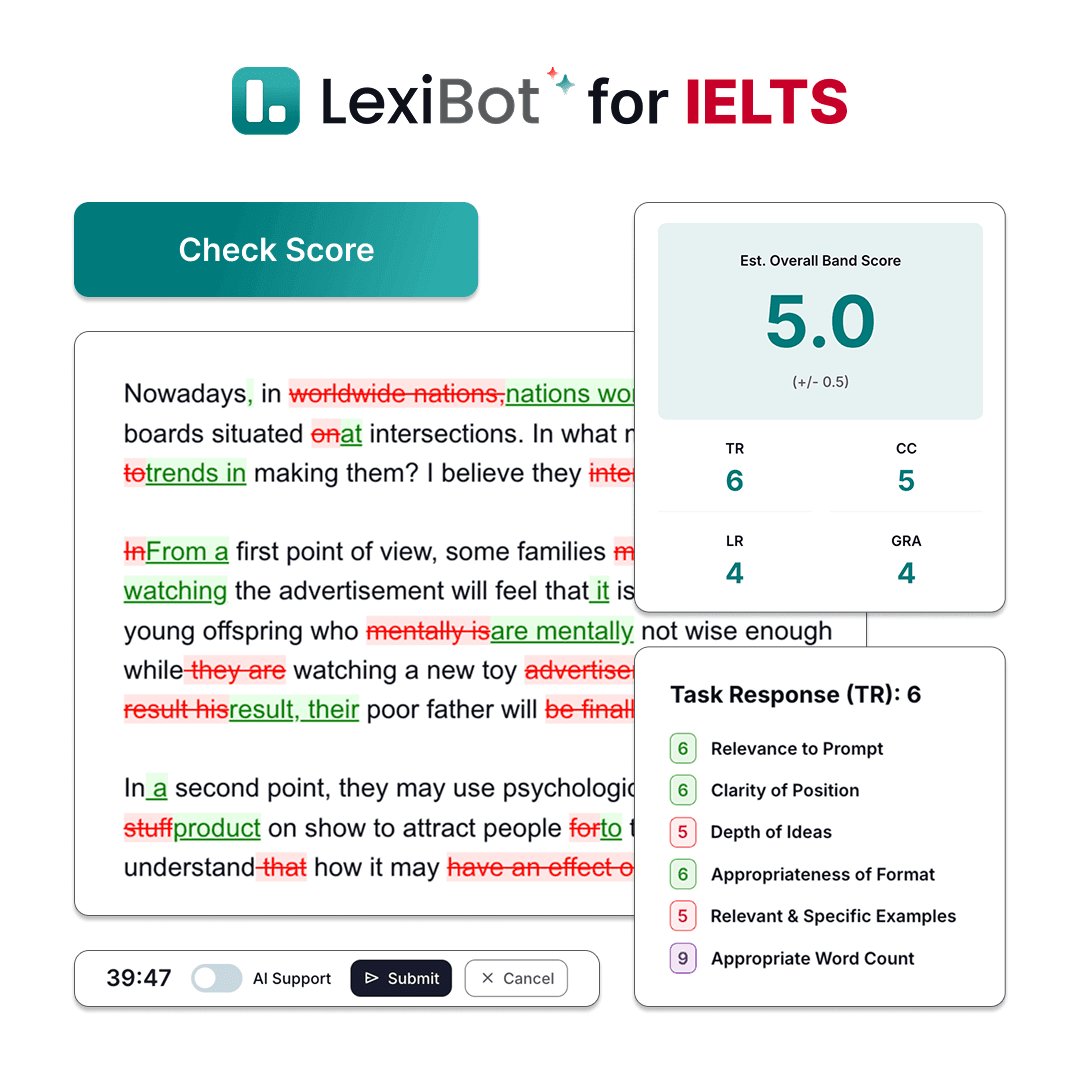
Nhận kết quả sau khi nộp bài
Nhận điểm số, đánh giá và hướng dẫn sửa bài chi tiết ngay sau khi nộp bài với LexiBot AI.
Nhiều ứng dụng & tính năng trong một nền tảng
Ôn luyện, chấm chữa, thi thử IELTS Writing, tất cả trong một.
for
IELTS
| Writing Checker
Chấm chữa IELTS Writing
350,000+ Người sử dụng
for
IELTS
| Writing Practice & Mock Test
70,000+ Người sử dụng
| Multilingual Grammar Checker
Kiểm tra chính tả đa ngôn ngữ
20,000+ Người sử dụng

